
USD Index
Over the past week, the US dollar has continued to weaken, partly due to rising expectations of future rate cuts by the Federal Reserve. However, the upcoming US Non-Farm Payroll (NFP) report on Friday could have a significant impact on market expectations. The ongoing government layoffs are expected to exert downward pressure on February’s job growth figures. However, if the private sector employment remains strong, it could offset the negative impact from government job losses.
- Last week, the USD Index stabilized at lower levels before rebounding. Although the bulls attempted a counterattack, the overall trend remains bearish. This week, key focus remains on the 107.50 level, which serves as a pivotal point between bullish and bearish sentiment.
- If the USD Index faces resistance and declines from the 107.50 level, watch for support at 105.56 and 104.36.
- If the USD Index breaks above 107.50, key resistance levels to monitor are 109.39 and 111.65.
EUR/USD
Trade and tariff issues continue to weigh on the euro’s outlook. Increasing foreign competition, high energy costs, persistently elevated interest rates, and an uncertain economic landscape have severely impacted Germany’s economy, which is experiencing contraction for the second consecutive year in 2024. As a result, the European Central Bank (ECB) is expected to cut rates for the sixth time since June, given that inflation has nearly reached its target and is expected to slow further in the coming months.
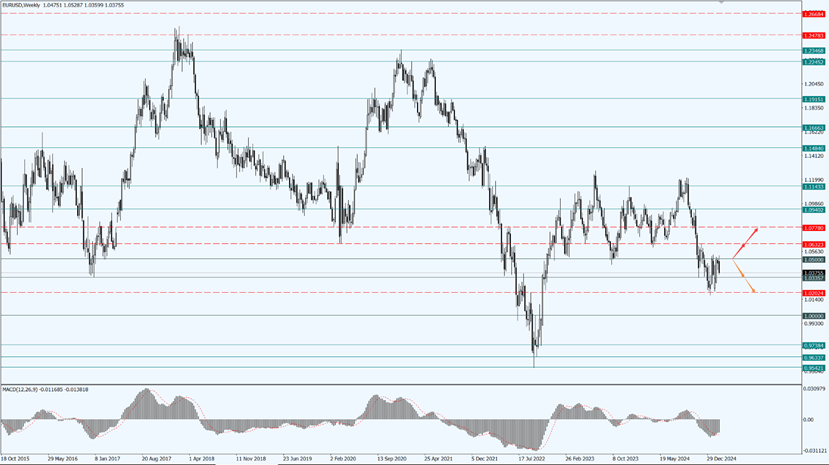
- Last week, EUR/USD faced heavy resistance at the key 1.05 level, leading to a sharp decline. The bearish momentum further pressured the bulls. This week, the 1.05 level remains a crucial pivot point.
- If EUR/USD struggles below 1.05, key support levels to watch are 1.0335 and 1.0202.
- If EUR/USD stabilizes and rebounds above 1.05, resistance levels to monitor are 1.0632 and 1.0778.
USD/JPY
The Japanese yen faced broad weakness due to soft Tokyo Consumer Price Index (CPI) data, which could weaken expectations of another Bank of Japan (BOJ) rate hike this year. Given this slowdown, the March monetary policy meeting is likely to maintain current policies to assess the impact of the January rate hike. Additionally, markets are closely watching inflation trends, wage growth, and the US tariff policy.
Due to recent volatility in the foreign exchange and Japanese government bond (JGB) markets, the BOJ is expected to be extremely cautious in signaling future rate hikes.
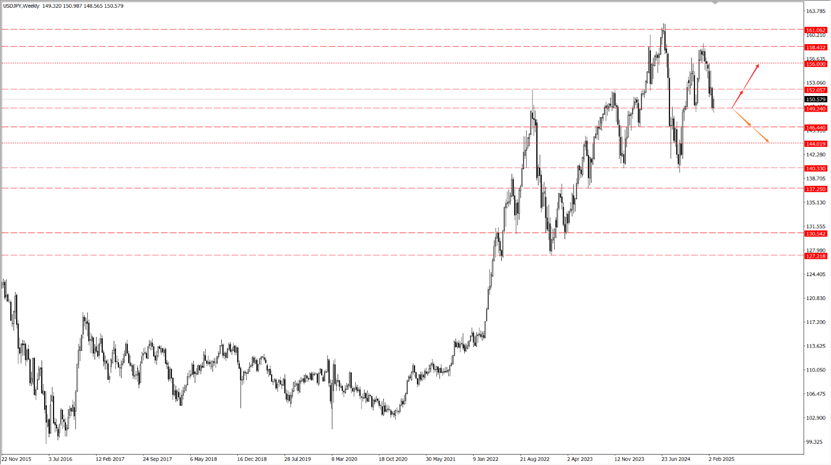
- Last week, USD/JPY found support and rebounded at the key 149.24 level. This week, the 149.24 level remains a major focus.
- If USD/JPY trades above 149.24, watch for resistance at 152.05 and 156.
- If USD/JPY faces pressure and falls back below 149.24, key support levels are 146.44 and 144.01.